
How eWaste Sydney’s Recycling Certificates Are ESG Compatible
Environmental, Social and Governance reporting increasingly requires organisations to maintain clear records of how they manage waste, retired technology and other environmental impacts.
For organisations disposing of IT equipment, a Certificate of Recycling can provide useful evidence that a collection was processed through a documented e-waste management process.
However, a recycling certificate is not an ESG certification by itself. Instead, it can form part of the supporting documentation an organisation uses for sustainability, procurement, environmental and internal reporting.
eWaste Sydney provides recycling certificates and supporting records for eligible e-waste and IT asset disposal projects across Australia.
What Is an E-Waste Recycling Certificate?
A Certificate of Recycling documents the completion of an e-waste recycling project.
Depending on the service and project scope, the certificate may include information such as:
- Client or organisation name
- Collection or processing reference
- Date
- Total equipment weight
- Recycling outcome
- Estimated CO₂ savings
- Relevant certification information
This creates a documented record that organisations can retain alongside their own waste, asset and environmental records.
How Recycling Records Can Support ESG Reporting
ESG reporting often draws information from many different parts of an organisation.
For IT equipment and electronic waste, useful supporting data may include:
- Quantity of equipment collected
- Total weight processed
- Equipment reused or recovered
- Equipment directed to recycling
- Data destruction records
- Asset audit information
- Environmental certificates
- Estimated environmental impact data
Therefore, recycling certificates can provide one source of evidence within a broader sustainability reporting process.
Environmental Reporting
The Environmental component of ESG commonly considers areas such as resource use, waste management, circular economy practices and environmental impacts.
For retired IT equipment, organisations may wish to document:
- E-waste volumes
- Recycling weight
- Reuse outcomes
- Material recovery
- Asset life extension
- Estimated CO₂ savings
- Responsible disposal processes
eWaste Sydney can provide recycling weight information and estimated CO₂ savings as part of its project reporting.
These figures can support an organisation’s own environmental analysis and disclosures.
Estimated CO₂ Savings
Where included in eWaste Sydney reporting, CO₂ savings are presented as estimated environmental impact figures based on the calculation methodology used for the project.
They should therefore be treated as estimates rather than independently verified carbon-accounting measurements.
Organisations using this information in formal sustainability or emissions reporting should assess how the figures fit within their own reporting methodology, boundaries and assurance requirements.
This distinction is important because a recycling certificate alone does not establish an organisation’s greenhouse-gas inventory or prove achievement of a carbon-reduction target.
Reuse and the Circular Economy
Recycling is only one possible outcome for retired technology.
Where suitable equipment still has useful life, reuse or refurbishment may provide a better circular-economy outcome than immediately dismantling the device for materials.
Depending on the equipment and client requirements, eWaste Sydney can assess assets for:
- Reuse
- Refurbishment
- Asset recovery
- Buyback
- Resale
Equipment that is unsuitable for reuse can then move through appropriate recycling channels.
View IT Asset Recovery & Buyback
Governance and Asset Accountability
The Governance component of ESG can include accountability, record keeping and documented processes.
For IT asset disposal, this may involve records such as:
- Collection details
- Asset serial numbers
- Asset tags
- Data sanitisation results
- Certificates of Data Destruction
- Certificates of Recycling
- Asset recovery reports
- Processing records
These records can help organisations demonstrate that they followed an agreed IT asset disposal process.
Data Security and ESG
Responsible IT disposal also needs to consider information security.
Retired laptops, desktops, servers and storage devices may still contain sensitive information.
Depending on project requirements, eWaste Sydney can combine environmental reporting with:
- Blancco secure data erasure
- Drive serial number reporting
- Physical destruction where required
- Certificates of Data Destruction
- Asset audit reporting
This allows organisations to address data-security requirements alongside environmental disposal objectives.
View Secure Data Destruction Services
Certifications Supporting Our E-Waste Processes
eWaste Sydney holds certification to:
- AS/NZS 5377:2013
- ISO 14001:2015
- ISO 45001:2018
These certifications support documented e-waste management, environmental management and occupational health and safety processes.
They do not mean that an individual client’s ESG report, carbon inventory or sustainability claim is independently certified by eWaste Sydney.
View Certifications & Compliance
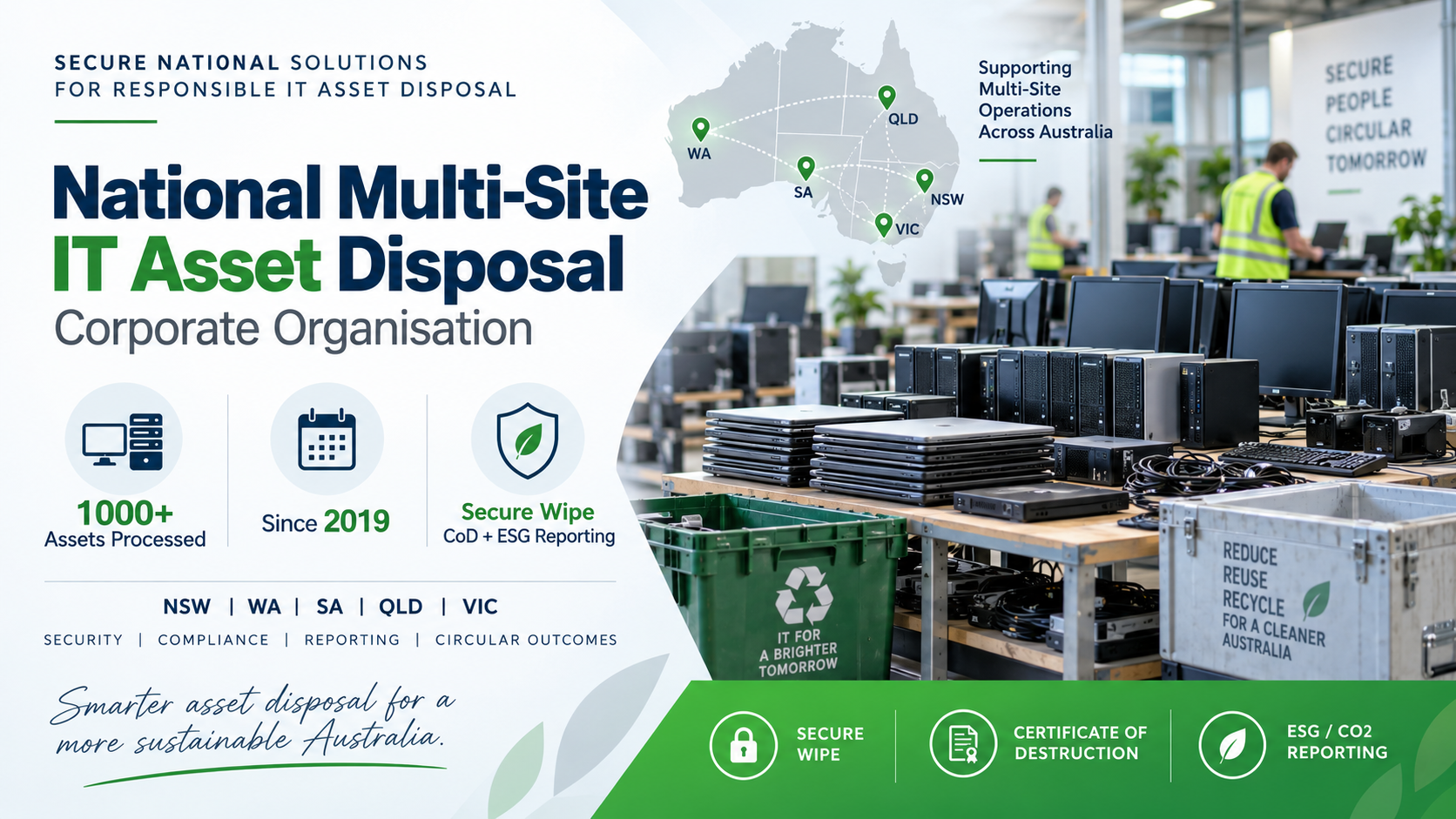
ESG Reporting for Multi-Site Organisations
Organisations operating across multiple locations may need consistent recycling and asset-disposal records from different sites.
A coordinated ITAD program can help standardise information such as:
- Collection locations
- Equipment weight
- Asset details
- Data destruction
- Recycling outcomes
- Certificates
- Estimated CO₂ savings
This can make it easier for internal sustainability, procurement and IT teams to consolidate information across a national program.
View our National Multi-Site IT Asset Disposal Case Study
How ITAD Supports Sustainability Reporting
A complete IT Asset Disposal program can combine:
- Secure collection
- Asset auditing
- Data sanitisation
- Asset recovery
- Reuse
- Recycling
- Certificates
- Environmental reporting
As a result, organisations can receive more useful disposal information than they would from a basic bulk e-waste collection alone.
View IT Asset Disposal Services
What a Recycling Certificate Does — and Does Not — Prove
A recycling certificate can provide evidence that an agreed recycling activity took place and document information such as weight and processing details.
However, it does not by itself:
- certify an organisation as ESG compliant
- independently verify its greenhouse-gas inventory
- prove achievement of Scope 3 targets
- certify the organisation’s sustainability report
- replace external assurance where required
Instead, the certificate provides supporting information that the organisation can incorporate into its own reporting framework.
Key Takeaways
E-waste recycling certificates can provide useful documentation for organisations preparing sustainability and ESG reports.
Their strongest value comes from providing traceable information about recycling activity, equipment volumes and environmental outcomes.
When combined with asset audits, secure data destruction, reuse, asset recovery and recycling records, they can support a more complete picture of how an organisation manages retired technology.
For organisations planning an IT refresh or national asset-disposal program: