
Sustainable E-Waste Management Practices for Businesses
Businesses regularly replace laptops, desktops, servers, monitors, networking equipment and other electronic devices.
Without a structured process, retired technology can create unnecessary waste, information-security risks and poor asset visibility.
A sustainable e-waste management strategy should therefore consider the complete lifecycle of IT equipment, from procurement and use through to reuse, asset recovery, secure data sanitisation and responsible recycling.
Here are practical steps organisations can implement.
1. Maintain an Accurate IT Asset Register
Effective e-waste management starts with knowing what equipment your organisation owns.
An asset register can record information such as:
- Asset tag
- Manufacturer
- Model
- Serial number
- Location
- Assigned user
- Purchase date
- Warranty status
- Device condition
- Retirement date
As a result, organisations can identify equipment approaching end of life and plan technology refreshes more effectively.
When equipment enters the disposal process, asset audit reporting can also help reconcile retired devices against internal records.
2. Extend Equipment Life Where Practical
Recycling should not automatically be the first destination for every retired device.
Where practical, organisations can extend equipment life through:
- Internal redeployment
- Component upgrades
- Repair
- Refurbishment
- Reuse
- Resale
For example, a laptop that no longer meets the requirements of one department may still be suitable for another purpose.
Extending useful life can reduce unnecessary equipment replacement and delay materials from entering the recycling stream.
3. Prioritise Reuse Before Recycling
When equipment leaves the organisation permanently, it may still retain useful life or commercial value.
Suitable laptops, desktops, servers and other technology may be assessed for:
- Reuse
- Refurbishment
- Asset recovery
- Buyback
- Resale
Equipment that cannot be reused can then move into appropriate recycling channels.
This approach supports a more circular model than simply treating every retired asset as waste.
View IT Asset Recovery & Buyback
4. Protect Data Before Equipment Leaves Service
Sustainable disposal must also consider information security.
Laptops, servers, hard drives, SSDs and other devices may retain sensitive information after employees stop using them.
Therefore, organisations should determine the appropriate sanitisation or destruction method before equipment is reused or recycled.
Depending on the media and security requirements, options may include:
- Blancco secure data erasure
- Verified sanitisation
- Physical destruction
- Drive serial number reporting
- Certificates of Data Destruction
Secure software-based sanitisation can also support sustainability because suitable equipment may remain available for reuse instead of requiring complete physical destruction.
View Secure Data Destruction Services
5. Establish a Documented IT Asset Disposal Process
Businesses can improve consistency by establishing a formal IT Asset Disposal (ITAD) process.
A structured ITAD program can combine:
- Equipment identification
- Secure collection
- Chain of custody
- Asset auditing
- Data sanitisation
- Physical destruction where required
- Asset recovery
- Reuse
- Recycling
- Final reporting
This provides a repeatable process rather than making disposal decisions separately each time equipment becomes redundant.
View IT Asset Disposal Services
6. Choose an Appropriate E-Waste Recycling Provider
Businesses should assess more than collection price when selecting an e-waste provider.
Useful questions include:
- What certifications does the provider hold?
- How will equipment be transported?
- How are data-bearing assets handled?
- Is serialised asset reporting available?
- Can reusable equipment be separated from end-of-life equipment?
- What happens to equipment after collection?
- What certificates are provided?
- What environmental reporting is available?
eWaste Sydney holds certification to:
- AS/NZS 5377:2013
- ISO 14001:2015
- ISO 45001:2018
View Certifications & Compliance
7. Include Sustainability in IT Procurement
Sustainable e-waste management starts before equipment reaches end of life.
When purchasing technology, businesses can consider factors such as:
- Expected device lifespan
- Repairability
- Upgrade options
- Warranty period
- Availability of replacement parts
- Energy efficiency
- Manufacturer take-back programs
- Potential resale value
Procurement teams can also work with IT departments to avoid unnecessary equipment replacement where existing devices remain suitable.
8. Create Clear Internal Disposal Procedures
Employees should know what to do when IT equipment becomes redundant.
An internal disposal policy can explain:
- Who approves equipment retirement
- Where redundant equipment should be stored
- How data-bearing devices should be handled
- Who records the asset
- Which equipment may be reused
- When an approved disposal provider should be contacted
This reduces the risk of equipment being discarded through general waste or leaving the organisation without appropriate records.
9. Plan for Technology Refresh Projects
Large technology refreshes can produce significant quantities of redundant equipment within a short period.
Therefore, organisations should plan disposal requirements alongside the rollout of replacement technology.
Before the refresh begins, consider:
- Number of devices being replaced
- Collection locations
- Asset reporting requirements
- Data-security requirements
- Potential asset recovery value
- Storage requirements
- Collection schedule
- Required certificates
Planning these requirements early can make the refresh more efficient.
10. Track Reuse and Recycling Outcomes
Organisations can improve sustainability reporting by recording what happened to retired equipment.
Depending on the project, useful information may include:
- Equipment quantities
- Collection weight
- Assets reused
- Assets recovered
- Equipment recycled
- Data sanitisation outcomes
- Certificates of Recycling
- Estimated CO₂ savings
These records can support internal environmental, procurement and ESG reporting.
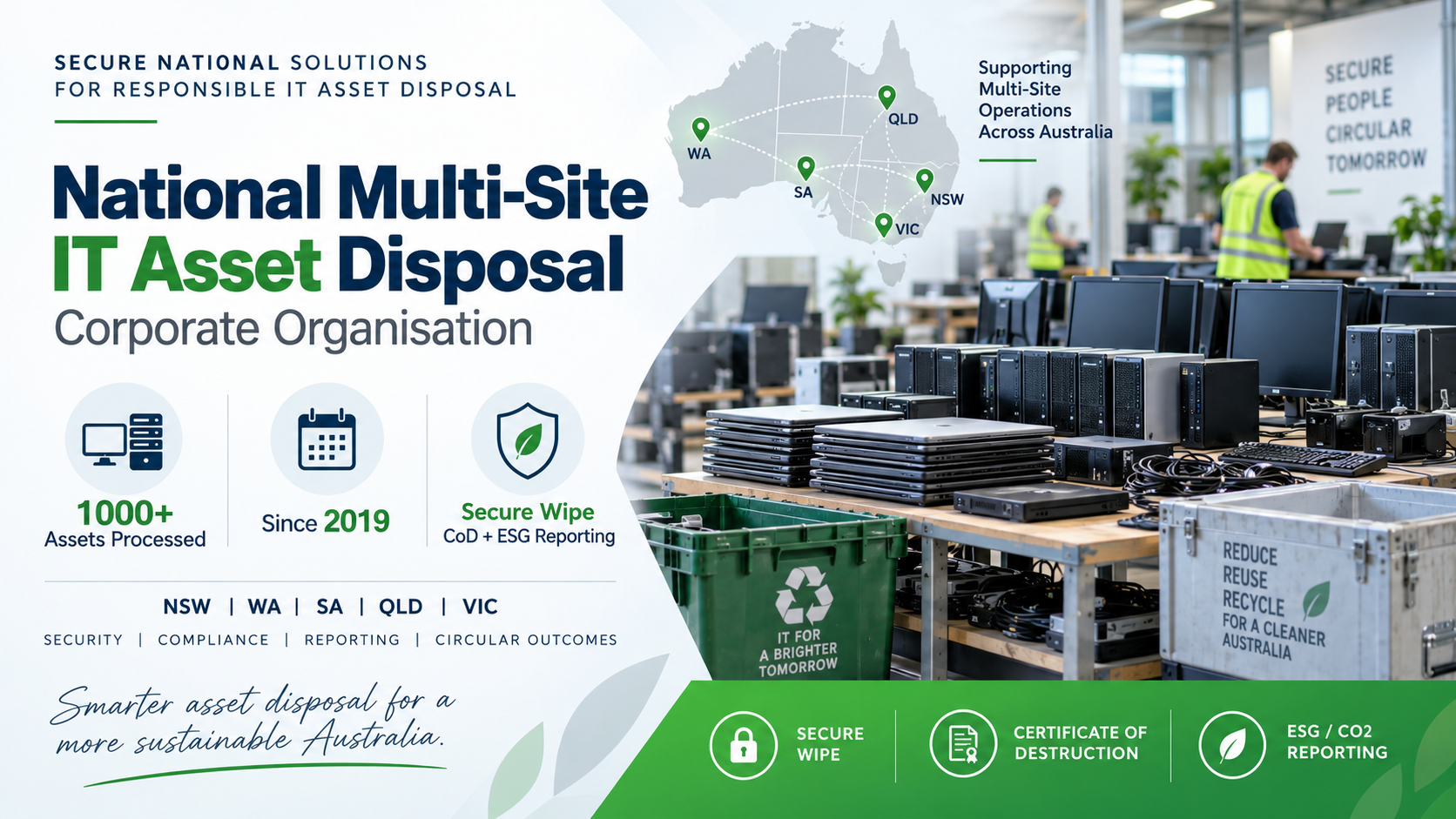
11. Use Consistent Processes Across Multiple Sites
Organisations operating from several locations can benefit from applying the same ITAD requirements across every site.
For example, a national disposal program can standardise:
- Asset reporting
- Data sanitisation
- Collection procedures
- Recycling requirements
- Certificates
- Environmental reporting
As a result, the organisation can maintain more consistent records across different offices and facilities.
View our National Multi-Site IT Asset Disposal Case Study
12. Educate Employees About E-Waste
Employee awareness can also improve e-waste management.
Staff should understand that unwanted electronics should not simply enter general waste streams.
Internal awareness programs can explain:
- Why e-waste requires appropriate handling
- Where redundant equipment should be returned
- Why data-bearing devices require additional controls
- How reuse supports sustainability
- Why asset records matter
Even simple internal procedures can reduce the risk of equipment being disposed of incorrectly.
Building a More Circular IT Lifecycle
Sustainable e-waste management is not only about recycling.
A more complete approach considers the entire technology lifecycle:
Purchase → Use → Maintain → Reuse → Sanitise → Recover → Recycle
By extending equipment life, protecting sensitive information, recovering value and responsibly recycling end-of-life technology, organisations can manage retired IT assets more effectively.
Key Takeaways
Businesses can improve their e-waste management by:
- Maintaining accurate asset records
- Extending equipment life
- Prioritising reuse
- Protecting data before disposal
- Establishing a documented ITAD process
- Using appropriately certified providers
- Considering sustainability during procurement
- Tracking recycling and reuse outcomes
- Applying consistent processes across multiple sites
- Educating employees
For organisations requiring collection, data sanitisation, asset recovery, recycling and reporting:
View IT Asset Disposal Services
or